Visiting a Reformed church: what to expect
A practical walk-through of a Reformed Sunday: arriving, seating, order of service, length, children, dress, collection, the Lord's Supper and coffee after.
Owen Sound Canadian Reformed Church is glad to have visitors, whatever church you grew up in or none. Here is what a first Sunday looks like.
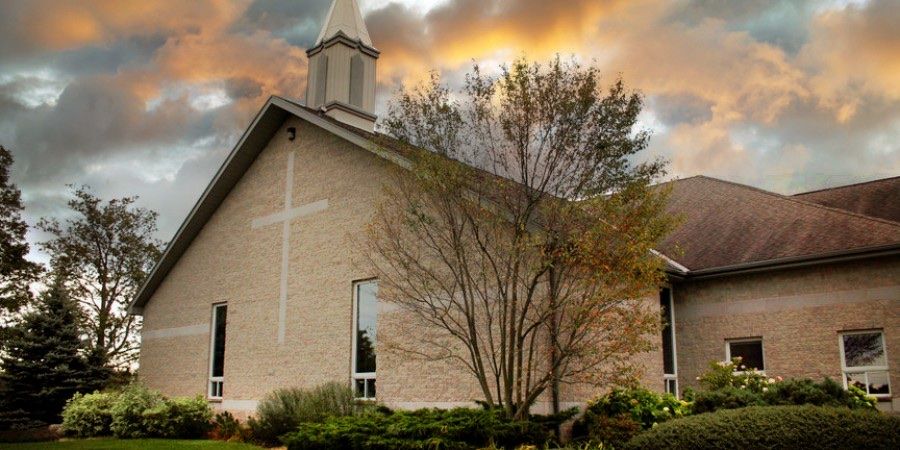
Owen Sound Canadian Reformed Church holds that the Holy Scripture is the Word of God and the only rule for faith and life. It confesses the three ecumenical creeds, the Apostles', the Nicene and the Athanasian, together with the Three Forms of Unity of the Dutch Reformation: the Belgic Confession, the Heidelberg Catechism and the Canons of Dort. The congregation's emblem is a Bible and an anchor, the anchor standing for Jesus Christ.
Owen Sound Canadian Reformed Church was instituted on 5 July 1992 and belongs to Classis Northern Ontario, the same classis as the congregations at Arthur, Elora, Fergus and Grand Valley. It is the only Canadian Reformed congregation on the Georgian Bay side of Grey County, and the nearest others are an hour or more to the south.
The church does not meet in the city. Its building is on Concession 5, off the road the congregation calls the Owen Sound by-pass, about five kilometres west of the hamlet of Rockford, and the congregation takes its mail at a post office box in Owen Sound. Two services are held every Sunday, at 9:30 in the morning and 2:30 in the afternoon.
The Canadian Reformed Churches were formed by Dutch immigrants who came to Canada after the Second World War and organized their own congregations from 1950, holding to the Three Forms of Unity. Worship is in English.
Come ten minutes early. Someone at the door will say hello and can point you to a seat; there is no sign-in and nobody will single you out.
Sit anywhere. Families sit together, and children of all ages stay in the service. A nursery or cry room is usually available if you need it.
A call to worship, singing (mostly Psalms, with hymns), the reading of Scripture, prayer and a sermon of about thirty minutes, then a closing song and blessing. A printed or projected order makes it easy to follow.
Roughly seventy-five to ninety minutes. Most congregations meet twice on Sunday; the afternoon sermon usually works through the Heidelberg Catechism.
Come as you are. You will see suits and dresses and you will see sweaters and jeans.
People linger to talk. If you would like to meet the pastor or an elder, just ask the person who greeted you.
Reformed churches confess the historic Christian faith of the Apostles', Nicene and Athanasian Creeds, summarized in three confessions from the sixteenth and seventeenth centuries: the Belgic Confession, the Heidelberg Catechism and the Canons of Dort. The short version is that God saves sinners by grace alone, through faith alone, on account of Christ alone, as the Bible alone teaches, and that his promises are for believers and their children.
Read the fuller description of the Canadian Reformed churches, or the guide to the Reformed churches of Ontario.
What you might find familiar, and what might feel different.
Mennonites and Reformed Christians have been neighbours in this part of Ontario for two centuries, and their stories go back to the same Reformation. The emphasis on discipleship and on community will feel familiar.
Reformed and Baptist churches agree on a great deal: the authority of Scripture, salvation by grace through faith, a serious view of membership. The visible difference is baptism, and it comes from a shared idea taken in two directions.
You may find more that is familiar at a Reformed church than you expect: a set liturgy, the creeds said together, the Lord's Prayer, and a reverence that takes worship seriously.
Reformed churches grew from the same Reformation soil. If you value the creeds, a set order of service and a church that has held its confession steady since the 1500s, a Reformed church will feel familiar.
Reformed churches share your conviction that the Bible has to be at the centre. What they add is a written confession that says exactly what the church believes, and a structure that keeps its leaders accountable.
If you are looking into the faith of the historic creeds, the Trinity, the divinity of Christ, salvation by grace, a Reformed church is a place where any question is welcome.
Reformed Christians believe the Holy Spirit is at work in every part of the Christian life. They expect to meet him first of all through the Word preached and the sacraments, and they pray for him to act.
If you come from a Christian Reformed, United Reformed or Free Reformed congregation, you will recognize nearly everything at a Reformed church: the same confessions, the same Psalms, much the same church order.
A practical walk-through of a Reformed Sunday: arriving, seating, order of service, length, children, dress, collection, the Lord's Supper and coffee after.
Plain-language summary of Reformed belief: grace, the Bible, covenant, the Three Forms of Unity, sacraments, church life and common misunderstandings.
Canadian, Christian, United and Free Reformed churches share one set of confessions. A fair guide to their histories, differences and how to tell them apart.
Balanced questions for choosing a church, whatever your background: Bible, preaching, sacraments, community, children, distance, doctrine and membership.
No need to let anyone know in advance. If you would rather ask a question first, send us a note.